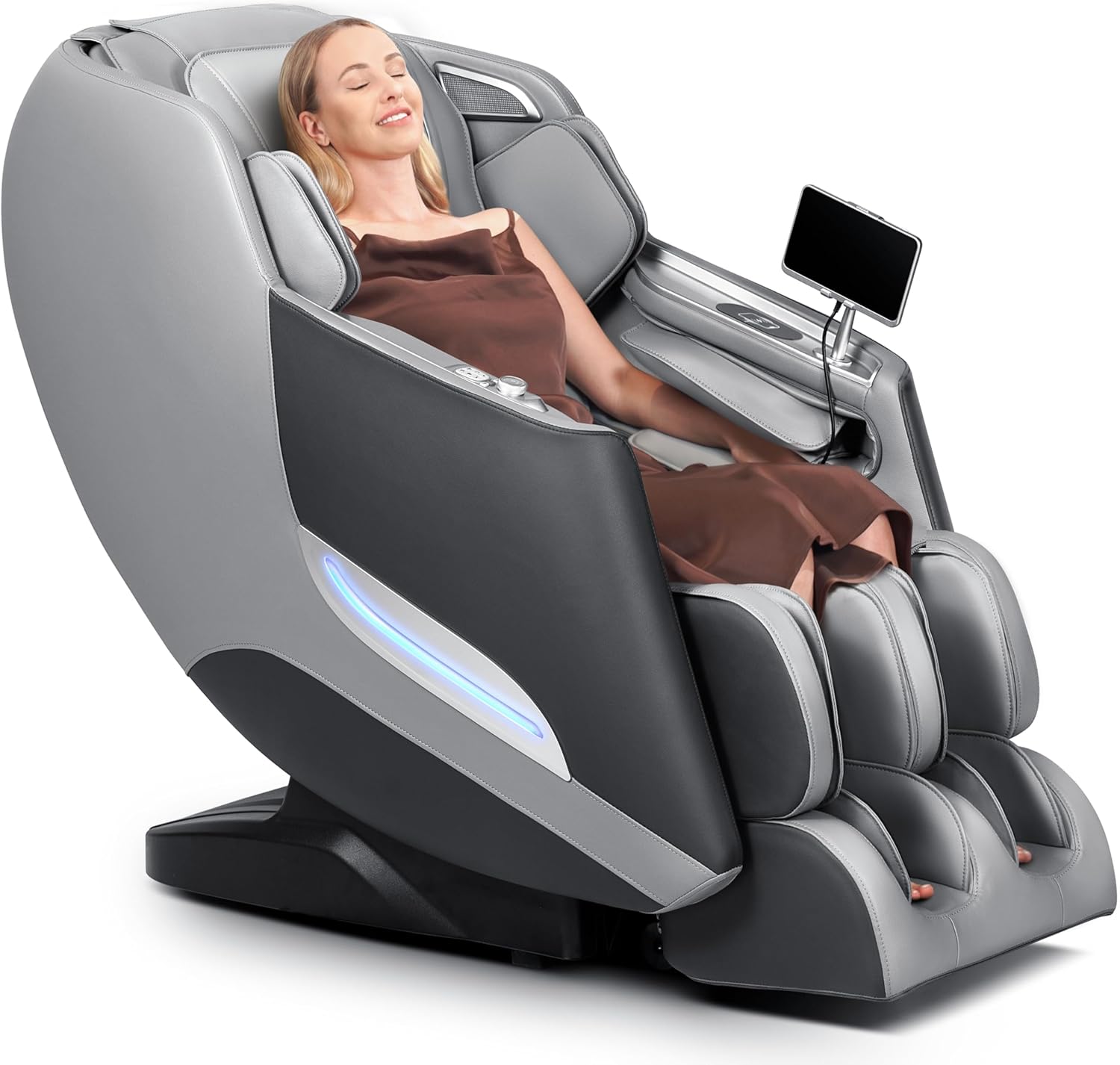
Mazzup MU411
A feature-rich 3D chair for shoppers who want SL-track coverage, zero gravity, heat, foot rollers and modern controls without paying for a dual-mechanism flagship.
We compared three very different levels of full-body massage chair: the Mazzup MU411 3D, MassaMAX MT339 4D, and Alfine A688 Heaven Duet 4D×3D. The goal is not to crown the most expensive chair automatically—it is to show what you gain, what you give up, and which type of buyer each chair makes the most sense for.
Affiliate disclosure: Review Central Guide may earn a commission from qualifying Amazon purchases. This does not change the price you pay. We have not personally tested these three chairs; this comparison is based on published specifications, manufacturer documentation and available customer feedback.

A feature-rich 3D chair for shoppers who want SL-track coverage, zero gravity, heat, foot rollers and modern controls without paying for a dual-mechanism flagship.

The middle option moves to a 4D mechanism and adds a more sophisticated feature set. It is the logical step for buyers who care about depth control, stretching and more program variety.

The luxury option is not simply “more 4D.” Its defining difference is a 4D×3D dual mechanism designed to work across two body zones, plus extensive leg/calf treatment and saved program customization.
All three chairs cover the basics expected from a premium full-body recliner. The meaningful separation is in the massage mechanism, adjustability, lower-body treatment, program depth and how much complexity you are willing to pay for.
| Feature | Mazzup MU411 | MassaMAX MT339 | Alfine A688 |
|---|---|---|---|
| Positioning | Premium 3D / value | Premium 4D / balanced | Luxury dual-mechanism |
| Massage mechanism | 3D | 4D | 4D × 3D dual mechanism |
| Track | 51-inch SL Track | SL Track | Long SL Track |
| Zero gravity | 3 levels | Yes | Yes |
| Automatic programs | 12 | Up to 27 on current MT339 generation* | 20 |
| Heating | Lumbar + calf | Heating system | Lumbar heating |
| Feet / calves | Foot rollers + compression | Foot rollers + extendable footrest | Foot rollers + calf rolling/kneading |
| Controls | Touchscreen + side controls | Touchscreen / voice / app on current generation* | Touchscreen + voice + quick controls |
| Customization | Good manual adjustment | Greater 4D depth/program control | Program customization + memory recall |
| Best fit | Feature value without flagship complexity | Buyer wanting a stronger technology jump | Buyer prioritizing maximum coverage and dual mechanisms |
*MT339 specifications can vary by listing/generation. Confirm the exact Amazon configuration before purchase.
Below, the strengths and weaknesses are separated so the purchase case does not depend on hype.
The MU411’s strongest argument is completeness. Published documentation lists a 3D mechanism, 51-inch SL track, three zero-gravity positions, lumbar and calf heat, full-body air compression, foot rollers, 12 automatic programs, six massage techniques, Bluetooth, wireless charging and an extendable leg rest.
That combination matters because it avoids the common “entry premium” compromise where a chair has zero gravity but uses a simpler fixed massage system. Here, the 3D mechanism allows front-to-back roller movement in addition to the track movement, giving the user more control over intensity.
The MT339 changes the character of the comparison because it moves into a 4D massage mechanism. Current product information also describes an SL track, body scanning, zero gravity, heating, deep yoga stretching, foot rollers, an automatically extending footrest and modern controls.
For a shopper who expects to adjust massage depth frequently, the 4D mechanism is a more meaningful upgrade than cosmetic extras. The MT339 also has a substantial user-feedback history across current listings, but feedback is not uniformly positive: some owners praise the adjustability and value while isolated reviews raise post-sale support or fit concerns.
The A688’s case rests on its dual mechanism. Alfine specifies a 4D×3D system, long SL track, full leg massage, automatic footrest extension, calf kneading and rolling, lumbar heat, zero gravity, touchscreen and voice controls, Bluetooth, 20 automatic programs, and program customization with memory recall.
That makes it fundamentally different from simply adding more preset modes. Two mechanisms can address different body zones in the same session, while memory recall is useful in a multi-user household. The trade-off is size and weight: published specifications put the chair around 290 lb, and customer feedback includes comments that broad-shouldered users can feel constrained.
A fair comparison should make the trade-off clear. Paying more is only worthwhile when the additional mechanism and controls are features you will actually use.
You care about a genuine 3D mechanism, long SL track, zero gravity, heat, foot rollers and convenience features, but do not need a dual-motor luxury platform. It delivers a surprisingly complete specification set for the first tier.
The MT339 is the most natural upgrade path: 4D depth adjustment, body scanning and a larger program set without jumping all the way to the cost and physical heft of the Alfine. For many buyers, this is where added technology is easiest to justify.
The reason to spend more is the dual 4D×3D architecture, broader lower-body attention and saved customization. It is easier to justify for frequent users or households where the chair will be part of a daily routine—not simply because it carries a luxury label.
All three have a credible reason to exist. The better purchase depends on whether your priority is feature value, a 4D upgrade, or a true dual-mechanism luxury experience.
Best argument: maximum everyday features before paying for 4D. Start here if value matters more than owning the most advanced mechanism.
Check Amazon →Best argument: the most balanced jump in technology. A sensible candidate for shoppers who specifically want 4D depth and more automation.
Check Amazon →Best argument: the strongest technical package. Consider it when dual mechanisms, lower-body treatment and saved programs justify the extra spend.
Check Amazon →